Best Hearing Aids for Severe Hearing Loss in 2027
Compare hearing aid options for severe hearing loss and learn why fitting, speech testing and follow-up matter.

The best hearing aid for severe hearing loss in 2027 depends on your hearing test, comfort and communication needs. Phonak Naída L-UP, ReSound Enzo IA and Phonak Audéo EON Sphere are examples with manufacturer-stated ranges that include severe hearing loss. Their suitability depends on the exact audiogram, fitting and device configuration.
These are examples from manufacturer information checked on November 20, 2026, not an independent head-to-head ranking. Other devices may also fit your needs. If your hearing loss came on suddenly or became worse quickly, seek medical care immediately rather than waiting for a hearing aid appointment.
Three Hearing Aids to Discuss
An audiologist can review how much amplification you need at different pitches and whether the device can provide it comfortably. A fitting range is a starting point, not proof that a device will work for every person within it.
Phonak Naída L-UP
Photo: Phonak.
Phonak lists Naída L-UP for severe to profound hearing loss. It is a behind-the-ear model; a tube connects the device to an earmold in the ear. Phonak lists a telecoil and wireless connectivity for this model. A telecoil can receive sound from compatible hearing loop systems, such as those installed in some public spaces.
Ask about: The earmold, available power, battery handling and compatibility with your phone or a remote microphone. Not every Naída L style has the same fitting range or power source.
ReSound Enzo IA
Photo: ReSound.
ReSound describes Enzo IA as a rechargeable super-power behind-the-ear option for severe to profound hearing loss. Its professional product page lists a telecoil, Bluetooth Low Energy Audio and Auracast support. Compatible public broadcasts, phones and accessories are required for the corresponding features.
Our Auracast deep dive explains the broadcast roles and the compatibility checks behind this feature.
Ask about: Fit and output with your earmold, charging and whether your phone and accessories support the functions you need. The manufacturer's feature claims do not establish that this device will outperform another model for you.
Phonak Audéo EON Sphere
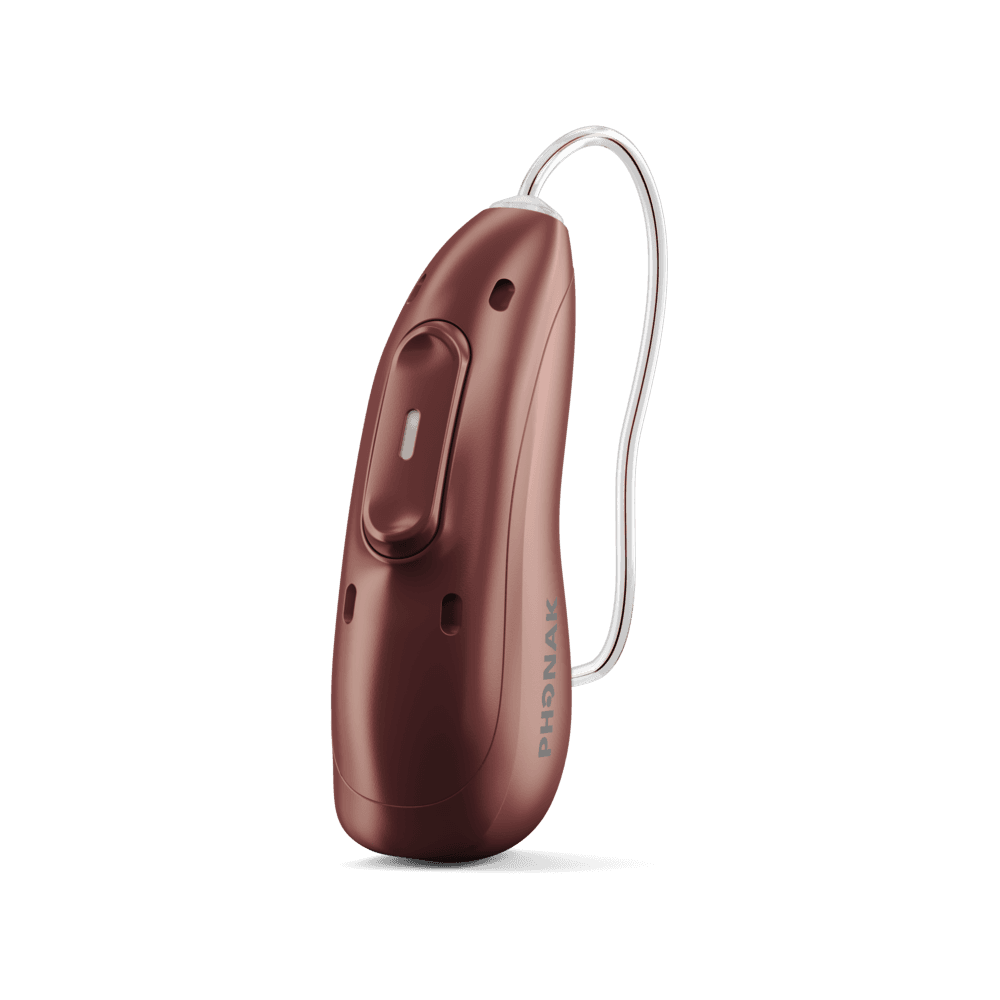
Photo: Phonak, as credited in the existing Singer Audiology comparison.
Phonak lists EON Sphere for mild to profound hearing loss. Unlike a power behind-the-ear device with an earmold and tube, this receiver-in-canal style uses a wire connected to a small speaker in the ear. Its stated broad range does not mean it will meet the amplification needs of every person with severe or profound loss.
Ask about: The appropriate receiver and coupling for your hearing test, whether the fitting can provide enough comfortable sound without feedback, and which options are available at the technology level quoted.
Check the Fitting and Your Listening Goals
Start with a hearing evaluation and describe your daily priorities. You may want to follow a conversation at home, hear a coworker across a table or understand calls with captions. Speech testing and your own account of difficult situations help guide the discussion.
Ask whether the fitting includes real-ear measurement. A small microphone measures sound in the ear so the professional can compare output with the fitting target. Follow-up visits give you a chance to discuss comfort, feedback and the sounds that remain difficult.
Ask about a compatible remote microphone for difficult listening situations. It picks up sound closer to a speaker and sends it to a hearing device; compatibility and benefit depend on the system, setting and listener. Captions, visual cues and communication strategies can also support conversations.
When to Ask About a Cochlear Implant Evaluation
If you still struggle to understand speech with appropriately fitted hearing aids, ask your audiologist whether a cochlear implant evaluation is appropriate. A hearing aid amplifies sound; a cochlear implant uses a surgically placed device to stimulate the auditory nerve. An evaluation is a way to learn about options, not a commitment to surgery.
Candidacy depends on more than a hearing-aid brand or a single hearing threshold. A specialist team assesses hearing, speech understanding and other medical factors under the relevant criteria. Some people use a hearing aid in one ear and a cochlear implant in the other; the team can explain whether that approach applies to you.
If hearing loss is much greater in one ear, the options can differ. Read our 2027 guide to single-sided hearing loss.
Plan Your Next Step
Compare the total price, trial terms, earmold, warranty, maintenance and follow-up as well as the device. Learn more about hearing aid fitting, or request an appointment with Singer Audiology to discuss your listening goals.
Sources
- Phonak. Naída Lumity product information, U.S. site.
- Phonak. Naída Lumity U.S. product information.
- ReSound. Enzo IA professional product information.
- ReSound. Enzo IA hearing aids.
- Phonak. Audéo EON Sphere product information, U.S. site.
- American Speech-Language-Hearing Association. Hearing Aids for Adults.
- American Speech-Language-Hearing Association. Cochlear Implants.
- National Institute on Deafness and Other Communication Disorders. Sudden Sensorineural Hearing Loss.